Errors rarely stay where they appear. They move through the process, carried forward by each step that follows. What starts as a small deviation at the beginning is often transformed, validated, and embedded deeper into the work until it finally becomes visible, usually at a point where it is much harder to understand and correct.
From the outside, these situations are often interpreted as quality issues. Someone did not check properly, someone missed a detail, someone allowed the error to pass. The focus quickly moves to individual attention and responsibility.
In practice, the pattern tends to be different. The issue is not that errors exist. Every system produces variation. The issue is that the process allows those errors to continue without interruption.
In many environments, work is designed to keep moving. Progress is associated with flow, and stopping is treated as an exception, sometimes even as a failure. When something feels slightly off, the natural reaction is to continue and address it later, under the assumption that correction will be easier or less disruptive downstream. Over time, this creates a system where problems are not resolved where they occur, but are carried forward and multiplied.
What follows is a gradual increase in control. Additional checks are introduced, validations become more frequent, and more effort is spent confirming what should have been clear earlier. These mechanisms are usually described as quality control, but in reality, they often function as compensation for a process that does not stop when it should.
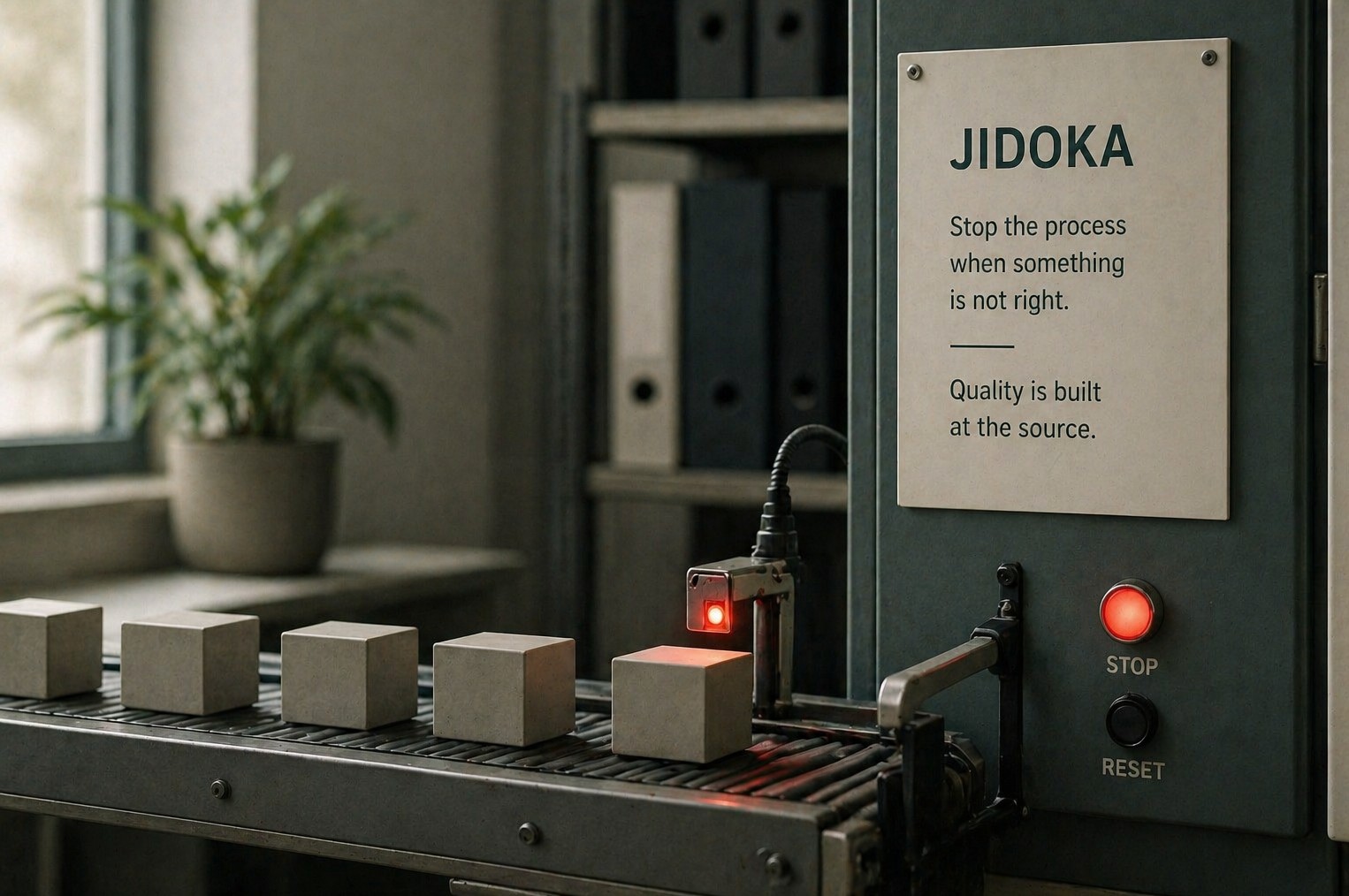
This is where the thinking behind Jidoka becomes useful. Not as a formal concept to be implemented, but as a different way to look at how quality is created. Instead of allowing work to continue and correcting issues later, the process is designed to stop when something is not right. This is not a dramatic interruption, and it is not treated as failure. It becomes a normal response, built into the way work flows.
When this kind of structure exists, problems become visible at the moment they appear. Because they are visible earlier, they remain smaller and easier to understand. The effort required to resolve them decreases, and the need to compensate later disappears.
The effect on behavior is also noticeable. When a system allows work to continue despite uncertainty, people compensate individually. They double-check, they revalidate, they hesitate before moving forward. Over time, quality becomes something that each person tries to protect on their own, because the process itself does not provide that protection.
When the system changes, this dynamic changes with it. When stopping is part of the process, responsibility becomes more evenly distributed between people and structure. Fewer issues reach later stages, fewer explanations are needed, and work becomes more stable without requiring additional effort.
There is also a subtle shift in how problems are perceived. If stopping is associated with failure, issues tend to be hidden or delayed. If stopping is understood as part of the process, issues surface naturally, without pressure. This difference shapes whether quality is inspected after the fact or maintained continuously as work progresses.
Jidoka is often described in technical terms, sometimes linked to automation. In practice, its impact is more straightforward. It reflects a system that does not allow errors to travel unchecked.
And when errors stop traveling, quality no longer depends on catching them at the end. It becomes part of how the work moves from the beginning.