Most personal improvement efforts fail in a very familiar way. They start with energy. New routines, new rules, new intentions. For a few days, sometimes a few weeks, everything feels aligned. Then daily life returns to its usual rhythm. Time becomes tight, decisions become rushed, and the new habits slowly disappear without a clear moment where things actually stopped.
From the outside, this looks like a discipline problem. In practice, it rarely is. What I’ve seen, both in organizations and in personal routines, is that inconsistency usually comes from something simpler: the absence of structure that can survive real conditions.
In personal life, improvement is often treated as a matter of will. Eat better, move more, focus, be consistent. The direction is clear, but the system that should support it is missing. Decisions are made in the moment, based on energy, mood, or available time. When those fluctuate, behavior follows.
This is where the logic behind Lean Six Sigma becomes surprisingly relevant outside of work. Not as a methodology to apply strictly, but as a way of thinking.
In structured environments, improvement does not depend on motivation. It depends on how work is designed. Processes are made visible, decisions are clarified, and unnecessary variation is reduced. Over time, consistency becomes easier because the system absorbs part of the effort.
The same dynamic appears in personal life, although it is less visible. When routines are undefined, every action requires a decision. When decisions are repeated daily without support, they become fragile. This is where most personal systems break. Not because the intention was wrong, but because the effort required to sustain it was underestimated.
I’ve noticed that small structural changes have a disproportionate effect. When a meal is planned in advance, eating well stops being a daily negotiation. When training time is fixed, it no longer competes with other priorities. When the next action is already decided, starting requires less resistance. These are simple adjustments, but they change the nature of the effort.
What is often interpreted as “lack of consistency” is, in many cases, a system asking for repeated decisions it was never designed to handle.
There is also a quieter effect that becomes visible over time. When structure is introduced, attention shifts. Instead of constantly deciding what to do, energy can move toward how to do it better. Small improvements become possible because the base behavior is stable. This is where continuous improvement actually begins. Not in moments of intensity, but in repeated actions that are slightly refined.
Without that stability, improvement remains theoretical. Another pattern I’ve seen is the tendency to overdesign personal systems. Too many rules, too many tools, too many changes introduced at once. This creates initial momentum, but it rarely holds. The system becomes heavier than the life it is supposed to support.
In practice, the most effective personal systems are the simplest ones that remain in place under pressure. They don’t rely on ideal conditions. They work on normal days.
This is also where a subtle shift happens. Personal improvement stops being about fixing oneself and starts being about designing better conditions. The focus moves from “Why can’t I stay consistent?” to “What in my system makes consistency difficult?”
That question changes the direction of effort. Efficiency, in this sense, is not about doing more. It is about reducing friction. Continuous improvement is not about constant change. It is about making small adjustments to something that already works.
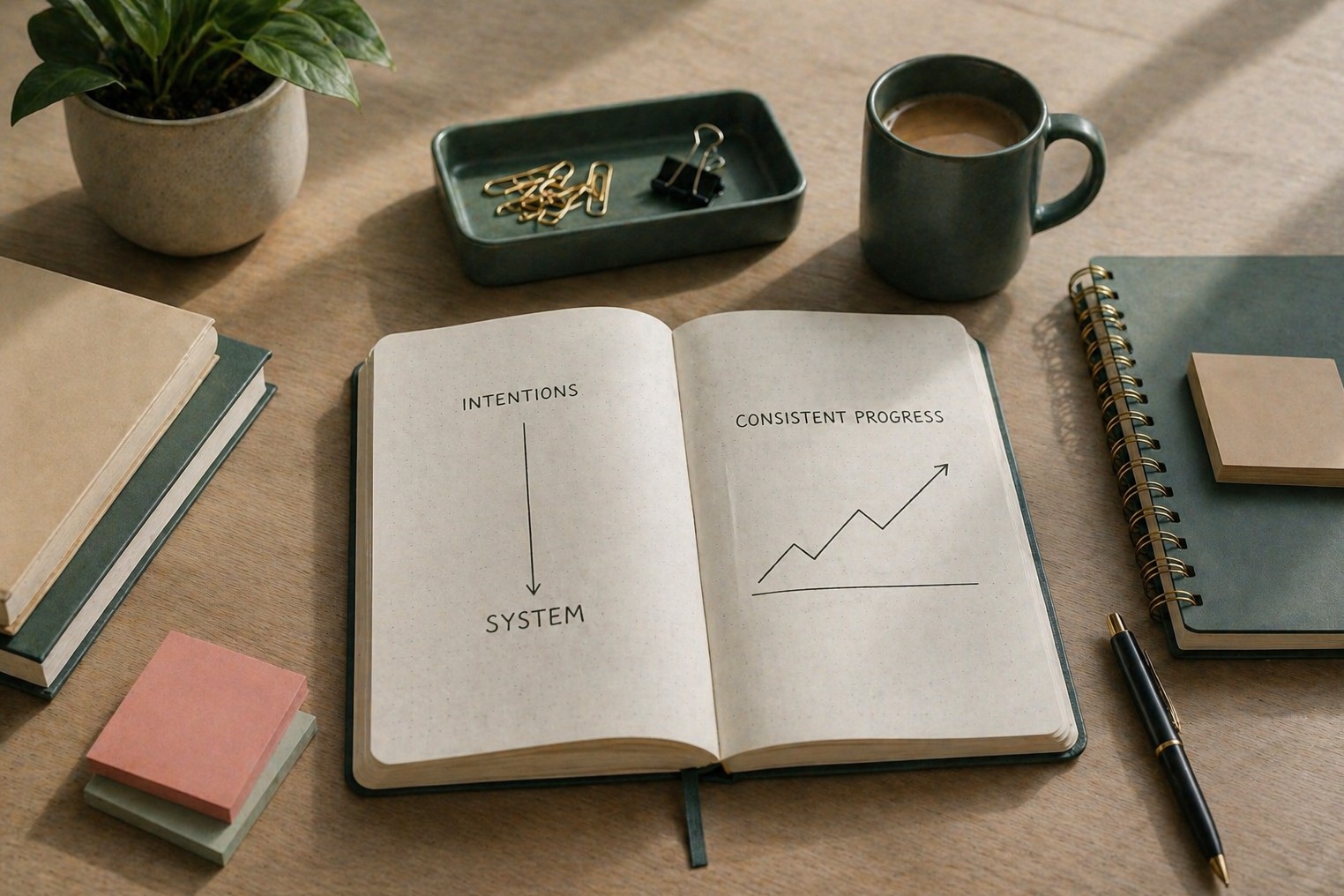
Over time, this creates a different experience of progress. Less intense, but more stable. Less visible, but more reliable.
The principles that improve organizations do not need to be translated into personal life as formal tools. Their value appears when the same thinking is applied: make things visible, reduce unnecessary decisions, and design for consistency instead of relying on effort. Improvement becomes quieter. And, more importantly, it starts to hold.